
Materiality Topic
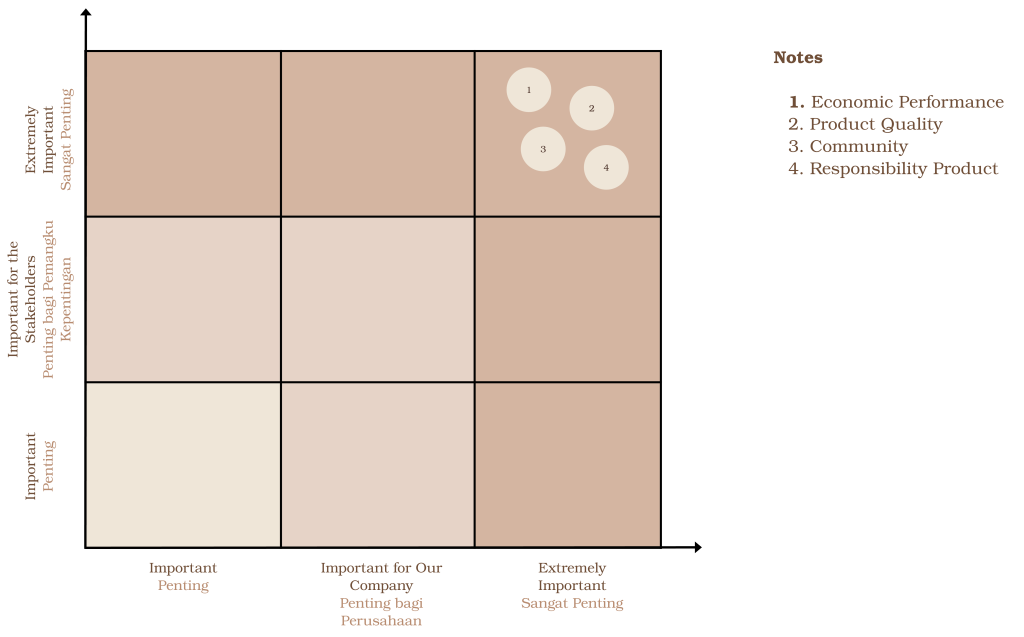
Material Topics are topics that reflect significant social, environmental, economic impacts of the reporting organization or substantially influence the judgments and decisions of stakeholders.
Economic Performance
Business continuity is largely determined by solid and stable economic performance. Therefore, steps are needed to improve the quality of economic performance to ensure business continuity is maintained.
Economic Performance
Business continuity is largely determined by solid and stable economic performance. Therefore, steps are needed to improve the quality of economic performance to ensure business continuity is maintained.
Product Quality
Business continuity also depends on the ability to offer high-quality and reliable products, which can strengthen customer loyalty.
Community
To produce quality coffee, the company works closely with the coffee farming community to ensure that the raw materials obtained meet the set standards.
Materiality Topic Matrix
DISCLOSURE OF ECONOMIC PERFORMANCE
Economic Value
Material Topics are topics that reflect significant social, environmental, economic impacts of the reporting organization or substantially influence the judgments and decisions of stakeholders.
Direct Economic Value - Income Generated
During the current year, PT Sinang Lembah Butuh generated an average turnover of Rp 2,800,000,000 and a net profit of Rp 680,000,000 in one year.
Direct Economic Value - Operating Costs
Business Expenses (production costs, operational costs, labor costs, facility maintenance costs, etc per year).
Average Nominal Per Year Nominal : Rp 120.000.000
Taxes for The Government
Average Nominal Per Year Nominal : Rp 1.700.000
Direct Economic Value - Employee Wage Standard
PT Sinang Lembah Butuh believes that the welfare of its workers, particularly non-permanent coffee farmers, has a direct influence on production quality and business sustainability. The Company implements a fair, transparent, and results-based remuneration system as a form of recognition for the tangible contributions made by farmers throughout the coffee production process.
The remuneration system at PT Sinang Lembah Butuh is based on the coffee harvest produced by each farmer. The level of compensation received is determined by the volume, quality, and market value of the coffee produced, thereby directly reflecting farmers’ productivity and performance.
In addition to being results-based, the Company ensures that the income received by farmers exceeds the applicable Regional Minimum Wage (UMR). This policy reflects the Company’s commitment to improving farmers’ welfare and creating decent and sustainable working conditions. With better income levels, farmers are expected to meet their basic living needs while maintaining high standards in coffee cultivation practices.
Domestic Content Level
Proportion of Local Suppliers - Local Supplier Geography
In carrying out its business operations, PT Sinang Lembah Butuh consistently relies on local suppliers, particularly those based in Magelang and the surrounding areas, to fulfill all of its raw material and operational needs.
PT Sinang Lembah Butuh optimizes its green coffee bean supply chain by taking into account various factors, such as sourcing, transportation, and storage, to ensure a stable, high-quality, and reliable flow of raw materials. This approach not only supports the continuity of the Company’s operations but also strengthens partnerships with local suppliers and contributes to the development of a sustainable coffee supply chain.
Proportion of Local Suppliers - Percentage of Products and Services Purchased Locally
The Company is committed to supporting local economic growth through the use of domestic suppliers. By prioritizing local suppliers, the Company is able to enhance supply chain efficiency, reduce the carbon footprint associated with transportation activities, and strengthen economic sustainability within its operational areas.
To date, PT Sinang Lembah Butuh has consistently sourced all products and services from local suppliers. Accordingly, 100% of the goods and services purchased by the Company originate from domestic suppliers, reflecting the Company’s commitment to responsible and sustainable procurement practices.
Types of Taxes Paid
PT Sinang Lembah Butuh fulfills its tax obligations in a disciplined and consistent manner in accordance with applicable laws and regulations. The Company regularly reports and pays its taxes on an annual basis as a demonstration of regulatory compliance and responsibility to the state.
The type of tax paid by PT Sinang Lembah Butuh is the Micro, Small, and Medium Enterprises (MSME) tax. The MSME tax is paid in accordance with the applicable rates and mechanisms, reflecting the scale of the Company’s business operations. Through consistent tax compliance, the Company contributes directly to government revenue and supports sustainable economic development.
DISCLOSURE OF ENVIRONMENTAL PERFORMANCE
Energy
Electricity
PT Sinang Lembah Butuh utilizes electricity to support its daily operational needs, including administrative activities and marketing operations. Based on payment records, the Company’s electricity expenses amounted to approximately IDR 50,000 for a two-month period. This figure reflects the relatively small scale of the Company’s operations as well as the efficient use of electrical energy. This limited and controlled use of electricity supports the smooth execution of the Company’s operational activities while also demonstrating PT Sinang Lembah Butuh’s efforts to use energy responsibly in line with its business needs.
Fuel
PT Sinang Lembah Butuh utilizes fuel to support its operational activities, particularly in the transportation of harvested coffee. Fuel is used to operate motor vehicles that transport coffee from farmers’ land to the company’s business facilities. During the reporting period, the company’s fuel consumption was recorded at approximately ±50 liters per month. The use of fuel is primarily focused on the distribution of harvested coffee, ensuring that the collection and processing of coffee can be carried out in a timely and efficient manner.
Water & Effluent
PT Sinang Lembah Butuh utilizes a natural water source in the form of a mountain spring to support its daily operational needs. Water usage is primarily dedicated to light operational activities, such as sanitation and supporting processes in small-scale coffee processing. The Company has not conducted quantitative recording of water consumption in liters, as the water is sourced directly from a natural spring. However, based on daily operational monitoring, water usage is estimated not to exceed 1 cubic meter (1 m³) per day. This reflects the relatively small scale of the Company’s operations as well as the efficient and prudent use of water resources.
Water Efficiency
The company implements efficient irrigation systems, such as drip irrigation or microirrigation, designed to reduce water loss due to evaporation and percolation. In addition, the company also routinely monitors and manages water resources, including keeping irrigation channels clean, repairing leaks, and optimizing the use of rainwater for plantation purposes.
Wastewater Management
PT Sinang Lembah Butuh utilizes fuel to support its operational activities, particularly in the transportation of harvested coffee. Fuel is used to operate motor vehicles that transport coffee from farmers’ land to the company’s business facilities. During the reporting period, the company’s fuel consumption was recorded at approximately ±50 liters per month. The use of fuel is primarily focused on the distribution of harvested coffee, ensuring that the collection and processing of coffee can be carried out in a timely and efficient manner.
Waste
Waste
PT Sinang Lembah Butuh generates solid waste originating from its coffee processing activities, in the form of coffee husks. Coffee husks are the only type of waste produced from the Company’s operational activities. Over the course of one year, the amount of coffee husk waste generated is estimated to reach approximately 2.4 tons. This waste is organic in nature and has the potential to be reused, allowing its management to support waste reduction principles and environmental sustainability.
Waste Management
A sorting system is applied in waste management to separate organic waste, such as coffee peels and pulp, from non organic waste. The organic waste has been utilized as raw material for composting.
Materials
PT Sinang Lembah Butuh ensures that the coffee beans it procures are certified organic, which means they are grown without the use of synthetic fertilizers, pesticides, or genetically modified organisms (GMOs).
The company obtains raw materials for organic coffee beans from various local suppliers, as the availability of high quality green coffee beans is critical to maintaining the integrity and sustainability of the company’s organic coffee production.
The coffee farmers who supply the coffee beans apply sustainable farming techniques, such as the use of natural and organic fertilizers, to maintain the health of the soil and surrounding ecosystem. The company conducts strict quality control to ensure only the best coffee beans are selected for processing, resulting in a superior end product and supporting the development of the local coffee industry.
Biodiversity
Despite its location near a conservation zone, all operational activities on the coffee plantations are carried out with due consideration for environmental protection and sustainability principles. Coffee cultivation activities do not involve land clearing, forest tree cutting, or the use of harmful chemicals that could potentially damage the protected forest ecosystem.
The Company ensures that clear boundaries between the coffee plantation area and the protected forest are properly maintained, preventing encroachment or disturbance to the forest’s ecological functions. Through this approach, PT Sinang Lembah Butuh’s operations remain aligned with environmental conservation efforts and support a balance between economic activities and the preservation of protected forest areas.
DISCLOSURE OF GOVERNANCE PERFORMANCE
Organizational Structure

Miftakhur Rokhman
Director

Hariyono
Business Development
M. Charissudin
Farmer Group Leader
Ashadi
Coordinator
M. Syarif
Warehouse
Organizational Structure
Organizational Structure List
The company implements a simple yet effective organizational structure to support smooth operational activities and ensure consistent coffee product quality. This structure is designed to promote clear communication, well-defined roles and responsibilities, and effective interdepartmental coordination, enabling all decisions and operational activities to be carried out accurately and responsibly.
At the highest level, the company is led by a Director, who is responsible for setting the strategic direction, business vision, and making key decisions related to business development and long-term sustainability. Reporting to the Director, the Business Development function plays a role in identifying market opportunities, expanding partnership networks, and enhancing the competitiveness of the company’s coffee products.
At the operational level, the organizational structure is supported by several key functions, namely the Farmer Group Leader, Coordinator, and Warehouse. Each function has specific roles and responsibilities that complement one another to ensure smooth operational execution.
This organizational structure is designed to ensure that the company can operate effectively, responsively, and consistently across the entire value chain, while also supporting the company’s commitment to sustainable practices and the development of local MSMEs.
Stakeholders Engagement
PT Sinang Lembah Butuh recognizes the importance of stakeholder engagement in supporting business sustainability. This engagement aims to identify material issues, as well as to enhance service quality and corporate governance.
PT Sinang Lembah Butuh has identified its key stakeholders. The stakeholder groups engaged by the organization include:
- Employees
- Customers
- Investors
- Communities (including suppliers)
- Government
- BNI Xpora
- Koperasi Lereng Kelir
Employee
Topic Discussed
- Internal business process
- Benefit
- Competency development
Method of Engagement: Evaluation meeting with all employees
- Once a month
Customers
Topic Discussed
- Product quality
- Good service
Method of Engagement: Interaction with customers and conducting market research
- As Needed
Investors
Topic Discussed
- Increased product supply
- Capital increase
- Profit sharing mechanism
- Business development plan in the next 5 years
Method of Engagement:Networking or friendship and investment cooperation proposal submission
- once per week
Community including suppliers
Topic Discussed
- Efficient processing, from nursery to selection of quality coffee beans
Method of Engagement: Through mentoring, training, and counseling for farmer groups and coffee farmers in the surrounding area
- Once a week every Friday Legi
Community including suppliers
Topic Discussed
- Community development and social support
Method of Engagement: Through various social community activities
farmers in the surrounding area
- as needed
Government
Topic Discussed
- The provision of land facilities and assistance by PPLs of the Agriculture Office aims to produce premium quality coffee through environmentally friendly agricultural practices
Method of Engagement: Direct assistance of designated officers.
- Once a month
Government
Topic Discussed
- Tax payment and reporting
Method of Engagement:Fulfillment of regulations or rules.
- According to the set time
Koperasi Lereng Kelir
Topic Discussed
- Marketing, distribution, and collective sales of coffee products to ensure fair prices and market access.
Method of Engagement:Regular coordination meetings with cooperative management
- Periodically, based on operational needs
BNI XPora
Topic Discussed
Financial support for business development:
- Adoption of modern technology in coffee processing
- Increased coffee and leech production capacity
- Infrastructure development, including packaging facilities and quality laboratories
Method of Engagement:Through special financing schemes for MSMEs
- As needed
BNI XPora
Topic Discussed
Export education and development support:
- Export management
- Global market-based product development
- International marketing strategy
Method of Engagement:Through export-related training programs, workshops and consultations
- As needed
Anti-Corruption and Customer Privacy
During the reporting period, PT Sinang Lembah Butuh did not record or identify any incidents related to corruption in any form. At present, the company has not yet established a formally documented anti-corruption policy due to its relatively small organizational scale. Nevertheless, all operational activities are carried out based on strong personal integrity, ethical conduct, and mutual trust among team members.
Customer Privacy
With regard to data protection, PT Sinang Lembah Butuh did not receive any complaints related to customer privacy breaches or the loss of customer data throughout the operational period. Customer information is managed in a simple and limited manner, and the company does not store significant amounts of sensitive customer data.
GRI INDEX
| Topic | GRI Index | Indicator | Page |
|---|---|---|---|
| GRI 2: General Disclosures 2021 | 2-1 | Organizational Details | 7 |
| 2-3 | Reporting Period, Frequency and Contact Point | 2 | |
| 2-6 | Activities, Value Chain and Business Relationship | 7 | |
| 2-7 | Employees | 7 | |
| 2-9 | Governance Structure and Composition | 46 | |
| 2-22 | Statement on Sustainable Development Strategy | 3 | |
| 2-29 | Approach to Stakeholder Engagement | 49 | |
| GRI 3: Material Topics 2021 | 3-1 | Process to Determine Material Topics | 17 |
| 3-2 | List of Material Topics | 17 | |
| 3-3 | Management of Material Topics | 17 | |
| GRI 201: Economic Performance 2016 | 201-1 | Direct Economic Value Generated and Distributed | 21 |
| GRI 204: Procurement Practices 2016 | 204-1 | Proportion of Spending on Local Suppliers | 23 |
| GRI 205: Anti-Corruption 2016 | 205-3 | Confirmed Incidents of Corruption and Actions Taken | 53 |
| GRI 302: Energi 2016 | 302-1 | Energy Consumption Within the Organization | 27 |
| GRI 303: Water & Effluents 2018 | 303-1 | Interactions with Water as a Shared Resource | 28 |
| GRI 304: Biodiversity 2016 | 304-2 | Significant Impacts of Activities, Products, and Services on Biodiversity | 32 |
| GRI 306: Waste 2020 | 306-2 | Management of Significant Waste-related impacts | 30 |
| 306-3 | Waste Generated | 30 | |
| GRI 401: Employment 2016 | 401-1 | New Employee Hires and Employee Turnover | 35 |
| 401-2 | Benefits Provided to Full-Time Employees That Are Not Provided to Temporary Employees | 35 | |
| GRI 403: Occupational Helath and Safety 2018 | 403-3 | Occupational Health Services | 40 |
| GRI 404: Training and Education 2016 | 404-2 | Programs for Upgrading Employees Skills and Transition Assistance Programs | 37 |
| GRI 406: Non-discrimination 2016 | 406-1 | Incidents of Discrimination and Corrective Actions Taken | 39 |
| GRI 408: Child Labor 2016 | 408-1 | Operations and Suppliers at Significant Risk for Incidents of Child Labor | 34 |
| GRI 413: Local Communities 2018 | 413-1 | Operations with Local Community Engagement, Impact Assessments, and Development Programs | 41 |
| GRI 416: Customer Health and Safety 2016 | 416-1 | Assessment of the Health and Safety Impacts of Product and Service Categories | 43 |
| GRI 418: Customer Privacy 2016 | 418-1 | Substantiated Complaints Concerning Breaches of Customer Privacy and Losses of Customer Data | 53 |
LESTARI INDEX
| Topic | Lestari Index | Indicator | Page | |
|---|---|---|---|---|
| Economic Value | E1.1 | Direct Economic Value | 21 | |
| Domestic Content Level | E2.1 | Proportion of Local Suppliers | 23 | |
| Tax | E3.1 | Types of taxes paid | 25 | |
| Energy | L2.1 | Energy Consumption | 27 | |
| Water and Effluent | L3.1 | Water Collection | 28 | |
| L3.3 | Water Disposal | 29 | ||
| Waste | E4.1 | Waste Generation | 30 | |
| Materials | E5.1 | Raw Material | 31 | |
| Biodiversity | E6.1 | Locations That Have an IMpact on Biodiversity | 32 | |
| Human Rights | S1.1 | Child Labor & Forced Labor Incidents | 34 | |
| Personnel, Training & Education | S2.1 | Number of Workers | 35 | |
| S2.3 | Average Training Hours per Year per Employee | 37 | ||
| S2.6 | Employee Training | 37 | ||
| Diversity, Equal Opportunity, Non-Discrimination | S3.4 | Incidents of Discrimination and Corrective Actions Taken | 39 | |
| Occupational Health and Safety | S4.4 | Occupational health services available to workers | 40 | |
| Local Community | S5.1 | Company Activities for Local Community Development | 41 | |
| Customer Safety and Labelling | S6.1 | List of Regulations/Certifications Complied with/obtained Related to Customer Safety and Health | 43 | |
| Organizational Structure | T1.1 | Organizational Structure Chart | 46 | |
| Anti-Corruption | T4.1 | Number of Corruption Incidents | 53 | |
| Customer Privacy | T5.1 | Number of Complaints Related to Privacy Violations | 53 |
DISCLOSURE OF SOCIAL PERFORMANCE
Human Rights
PT Sinang Lembah Butuh is committed to respecting and protecting children’s rights by not employing underage workers in any of its operational activities. All employees and coffee farmers associated with the Company are above 20 years of age, thereby complying with applicable minimum working age regulations.
In addition to ensuring compliance with age requirements, PT Sinang Lembah Butuh actively prevents the occurrence of child labor by implementing responsible labor practices and conducting oversight of field operations. This commitment forms part of the Company’s efforts to create a safe, ethical, and sustainable working environment.
Personnel, Training, and Education
The company has three main workers: a warehouse worker, a coordinator, and a farmer group leader. As part of its commitment to implementing best practices in Occupational Safety and Health (OHS), the company sets a structured work schedule. The company’s operational hours are Monday to Friday, 08.00-17.00 WIB, and Saturday, 08.00-13.00 WIB. With this schedule, employees are given a day off every Sunday, ensuring they have adequate rest time.
In addition, the company has also registered its workers in the BPJS Employment and BPJS Health programs, so that they can enjoy the benefits of protection in occupational safety and health.
Employee Remuneration
PT Sinang Lembah Butuh believes that the welfare of its workers, particularly non-permanent coffee farmers, has a direct influence on production quality and business sustainability. The Company implements a fair, transparent, and results-based remuneration system as a form of recognition for the tangible contributions made by farmers throughout the coffee production process.
The remuneration system at PT Sinang Lembah Butuh is based on the coffee harvest produced by each farmer. The level of compensation received is determined by the volume, quality, and market value of the coffee produced, thereby directly reflecting farmers’ productivity and performance.
In addition to being results-based, the Company ensures that the income received by farmers exceeds the applicable Regional Minimum Wage (UMR). This policy reflects the Company’s commitment to improving farmers’ welfare and creating decent and sustainable working conditions. With better income levels, farmers are expected to meet their basic living needs while maintaining high standards in coffee cultivation practices.
Employees Training
As part of its efforts to develop competent human resources, PT Sinang Lembah Butuh plays an active role in the development of its employees and the local farming community. The Company is committed to enhancing human resource capacity while encouraging the implementation of sustainable agricultural practices within its operational areas.
PT Sinang Lembah Butuh regularly conducts training programs for its employees to improve their competencies, knowledge, and work quality. Training is conducted at least once a year, with no maximum limit on the number of training sessions. Each training session has an average duration of approximately 3 hours, with total training hours provided to employees reaching around 48 hours per year. These programs are expected to support improved employee performance and contribute to the long-term sustainability of the Company’s operations.
In addition to employee training, PT Sinang Lembah Butuh actively provides training for local coffee farmers. The training covers various aspects, including organic farming practices, more effective crop management, and the use of modern agricultural technologies, such as the introduction of coffee processing machinery. Training sessions for farmers are conducted regularly once a week, specifically every Friday Legi.
Through these ongoing training initiatives, farmers not only gain knowledge of the latest agricultural technologies and practices but also enhance their technical skills. As a result, productivity and the quality of agricultural outputs improve, creating added value for farmers and strengthening the sustainability of the agricultural community as a whole.
Diversity, Equal Opportunity, Non Discrimination
During the reporting period, PT Sinang Lembah Butuh did not receive any reports or complaints related to discriminatory practices, whether based on gender, age, social background, or other forms of discrimination. The Company is committed to creating a safe, inclusive, and mutually respectful working environment for all employees and business partners.
Occupational Health and Safety
PT Sinang Lembah Butuh currently does not have a formally documented Occupational Health and Safety (OHS) Standard Operating Procedure (SOP) specifically for its coffee products. Nevertheless, the Company continues to apply OHS principles in its daily operations, including the implementation of safe working practices, careful use of equipment, and attention to providing proper working conditions for employees and farmers.
As part of its OHS implementation efforts, PT Sinang Lembah Butuh also provides OHS training to employees through regular briefing sessions. These briefings are intended to raise employees’ awareness of the importance of occupational health and safety, highlight potential workplace risks, and ensure that all operational activities are carried out safely.
Meanwhile, for another product produced by the Company, namely leech products, PT Sinang Lembah Butuh has a separate OHS SOP that is applied specifically in accordance with the characteristics and risks associated with that product. Going forward, the Company is committed to continuously improving OHS management and documentation in line with business development.
Local Community
Job Opportunities
PT Sinang Lembah Butuh creates employment opportunities for local residents, both in the process of planting, maintaining and processing coffee. This helps reduce the unemployment rate in the area and has a positive impact on the local economy.
Partnership with Local Farmers
To increase farmers’ income, the company partners with local farmers who supply coffee beans. By purchasing coffee beans from local farmers using fair prices, the company supports the economic growth of the region and the welfare of farmers.
Environmental Sustainability
Through organic farming practices and sustainable environmental management, PT Sinang Lembah Butuh helps to preserve the environment, including the maintenance of water and soil resources which are important assets for local communities.
Gender Women's Empowerment and Gender Equality
PT Sinang Lembah Butuh supports gender equality by providing employment and training opportunities for women in the community. These initiatives help improve women’s skills, strengthen their role in the economic sector, and encourage empowerment in agriculture.
Local Infrastructure Development
The company contributes to infrastructure development in the surrounding area, including road improvements, provision of educational facilities, and access to clean water sources. For clean water, the company utilizes mountain springs that are collected in reservoirs and channeled to residents’ homes using pipes, thus supporting the daily needs of the community.
CSR Funding Assistance
PT Sinang Lembah Butuh contributed through Corporate Social Responsibility (CSR) funds in the form of organizing a community party to celebrate the first coffee harvest. The event involved various stakeholders, including the village government, farmer groups from nearby areas, and relevant agencies in Magelang District.
Customer Safety and Labelling
Product Quality
The company ensures that the coffee beans produced meet the highest quality standards. This includes the selection of quality beans, meticulous processing, and regular quality testing to ensure a superior end product.
Compliance with Organic Standards
PT Sinang Lembah Butuh complies with all applicable regulations and standards for organic products. This includes the use of appropriate organic farming methods, responsible waste management, and efforts to maintain environmental sustainability around the plantation.
Labeling Transparency
The company provides clear and accurate information about organic coffee products. This includes the inclusion of organic labels, expiration dates, as well as relevant certifications such as PIRT and Halal to ensure consumer confidence.
Supervision and Monitoring
The supply chain of organic coffee products is closely monitored through regular monitoring. This supervision covers the materials used in processing, the transportation process, and the storage of coffee beans so that quality is maintained.
Communication with Consumers
PT Sinang Lembah Butuh actively communicates with consumers to convey its commitment to quality products and sustainability. This information is conveyed through product packaging, websites, and relevant educational campaigns.
Continuous Improvement
The company continuously strives to improve environmentally-friendly farming practices and empower local farmers. This involves innovations in farming methods, more efficient processing and effective reduction of environmental impacts.